Eric F. Box Funeral Directors
Celebrating remarkable lives with memorable funerals
Iconic Funerals – Stan Laurel (1890-1965)
With a passion for performing thanks to theatre-dwelling parents, Stan Laurel began his acting career on stage alongside Charlie Chaplin.
By 1927, was well on the way to realising his American dream when he met the man that would be his on-screen partner and closest friend, Oliver Hardy. After massive success as comedy duo, Hardy died in 1957, leaving behind a devastated Laurel, who decided that without his friend and partner, he would retire from acting.
After having starred in nearly 190 films and achieving his lifelong dream, Laurel’s hard work was rewarded in 1961 when he received the prestigious Lifetime Achievement Academy Award.

Laurel & Hardy © by twm1340
Laurel’s final years were spent in a small apartment in a Santa Monica Hotel. He was well-known for dedicating a great deal of his time to his fans, answering mail and even phone calls. A heavy smoker until around the age of seventy, Laurel died on the 23rd February 1965, a few days after having suffered a heart attack. Minutes from death, Laurel is said to have told his nurse that he wouldn’t mind going skiing, to which the nurse replied that she had not know he was a skier. “I’m not”, said Laurel, “I’d rather be doing that than have all these needles stuck into me!”. A few minutes later, the nurse found Laurel to have quietly passed away.
“…this man was the funniest”
At his funeral, Laurel’s good friend, Dick van Dyke gave the eulogy. Silent screen comedian, Buster Keaton was also present and was overheard declaring that “Chaplin wasn’t the funniest, I wasn’t the funniest, this man was the funniest”. Laurel wrote his own epitaph and true to form, his last words were written in the unique brand of humour that had made him so famous: “If anyone at my funeral has a long face, I’ll never speak to him again”.
He was buried at Forest Lawn in the Hollywood Hills Cemetery, Los Angeles.
Burials through time: THE SPARTANS
Life in Sparta was almost a daily exercise in survival.
Sparta, a prominent city-state in ancient Greece from around 650BC, was largely a militarist state with strict fitness and strength regimes beginning virtually at birth. Newborn babies would be bathed it in wine to see whether the child was strong. If the baby survived it was brought before the Gerousia by the child’s father. If it was considered “puny and deformed”, the baby was thrown into a chasm on Mount Taygetos.
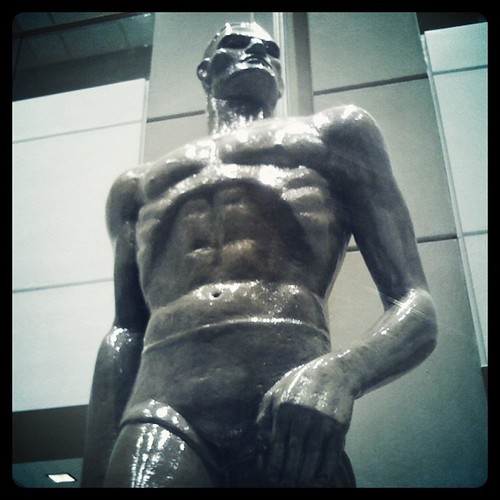
The Spartan - at Michigan State University © by betsyweber
Effectively, this was a primitive form of eugenics – a practice which advocates methods of improving the genetic composition of a population.
At the age of seven, boys entered the Agoge system, which was designed to encourage discipline and physical toughness. They lived in communal messes and were underfed to encourage them to master the skill of stealing food. As well as physical and weapons training, the boys also studied reading, writing, music and dancing.
At the age of twelve, the Agoge obliged Spartan boys to take an older male mentor, usually an unmarried young man. There is also reasonably certainty that they had sexual relations as part of their culture.
At the age of eighteen Spartan boys became reserve members of the army and some were sent into the countryside to seek out and kill any helots as part of the larger program of terrorising and intimidating the helot population.
When Spartans died, marked headstones would only be granted to soldiers who died in combat during a victorious campaign, or women who died either in service of a divine office or in childbirth.